How to Choose Audit Log Software for EU Marketplaces
How European marketplace compliance and legal leaders should evaluate audit log software: coverage, tamper resistance, retention, and framework mapping across GDPR, SOC 2, and ISO 27001.
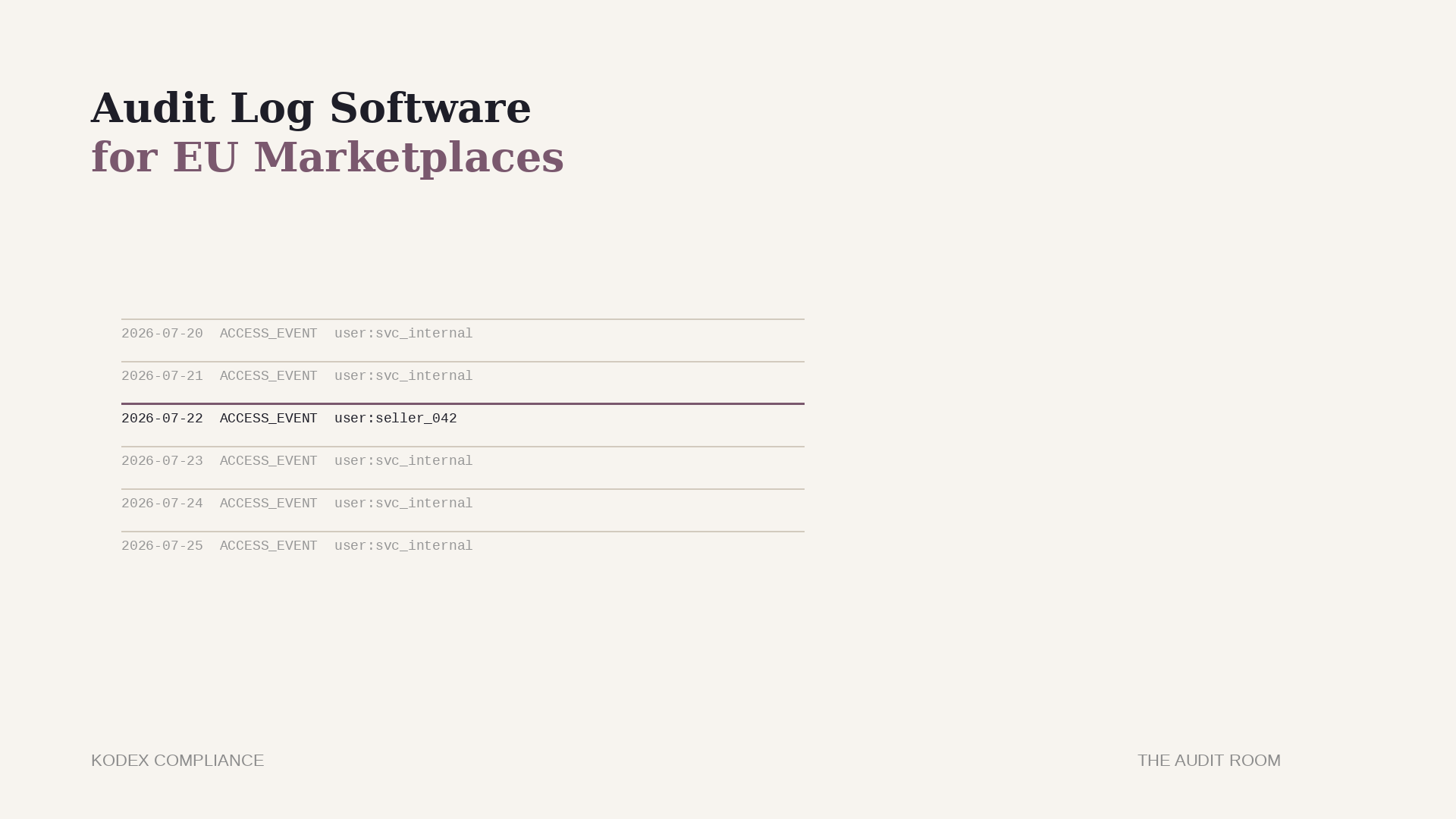
European marketplaces sit under a different compliance spotlight than most SaaS businesses. GDPR sets clear expectations for data access and processing records, and enterprise sellers or buyers increasingly ask marketplaces to prove exactly who accessed what, and when. Audit log software is the layer that makes this provable rather than assumed. Here is how to evaluate it properly.
Why audit logs matter more for marketplaces
A marketplace typically has more distinct actors touching data than a single-tenant SaaS product: internal staff, seller accounts, buyer accounts, and often third-party integrations. Each of those needs its own trail. Regulators and enterprise partners are not just asking whether you have a policy about data access. They are asking for the log that shows the policy was followed.
What to look for in audit log software
Coverage across every internal system that touches customer or transaction data matters, not just the primary application, since gaps in coverage are the most common reason an audit trail fails to answer a question during an actual audit. Tamper resistance matters too: a log that can be edited after the fact is not an audit trail, it is a document, so look for software that makes log entries immutable once written. Retention should match your regulatory exposure, since GDPR-relevant logs and payment-related logs often carry different retention expectations, and the software should let you set retention per log category rather than a single blanket period. Search and filtering that a non-engineer can use matters as well, since a legal or compliance lead should not need to file a ticket with engineering to query the log. Finally, export formats should match what auditors and regulators actually request, rather than a proprietary format that needs translation before anyone outside the company can read it.
Mapping to your specific frameworks
Audit log requirements show up differently across GDPR, SOC 2, and ISO 27001, and a marketplace often needs to satisfy more than one. Software that maps a single log entry to the specific control or article it supports saves significant time compared with maintaining separate evidence for each framework.
Where this fits into a broader compliance program
Audit logs are one piece of a larger evidence chain. On their own, they answer what happened. Paired with named control ownership and a review cadence, which is the model Kodex Compliance is built around, they answer the more useful question: who is accountable for this, and can we prove it is working. For a European marketplace weighing audit log software, the real question is not just which vendor has the most integrations, but which one turns your log data into something a regulator or enterprise customer can actually be shown with confidence.
If you want to see how Kodex handles audit logging and evidence mapping for a DACH or EU marketplace, talk to us: https://2gnhbv.share-eu1.hsforms.com/2Cd-BEz_vQv62FetiP_YmdQ
Sources
The regulatory references in this article are general summaries for informational purposes and reflect our interpretation of the underlying rules. They are not legal advice. Confirm applicability to your organization with qualified counsel.
GDPR Article 15, Right of access to personal data: gdpr-info.eu/art-15-gdpr
GDPR Article 30, Records of processing activities: gdpr-info.eu/art-30-gdpr
Build the evidence trail
Kodex Compliance helps teams turn questionnaires, documents, implementation proof, and reviewer decisions into a clear compliance record.
Request demo