How to Scale Legal Request Management in 2026
Why digital platforms struggle to manage government inquiries and privacy requests efficiently without compliance software, and how structured workflow management improves speed, consistency, and control.
Large tech and digital platforms increasingly receive legal requests that have nothing to do with customer support: government inquiries, law enforcement data requests, and privacy requests tied to specific regulations. Each one carries a deadline, a specific legal basis, and consequences for getting it wrong. Most legal teams handle the first few of these fine. The trouble starts when volume grows and the process is still built around individual judgment rather than a repeatable workflow.
Why volume breaks an informal process
A handful of government inquiries a year can be managed by one lawyer tracking deadlines in a calendar. Once that number grows, or once several people need to be involved in triage, response, and sign-off, an informal process starts to fail in predictable ways. Requests get missed or answered late. Two people give inconsistent answers to similar requests because neither can see what the other has done. There is no clear record afterward showing that a request was handled correctly, which becomes a problem the next time a regulator asks about the platform's process rather than a single incident.
What structured workflow management adds
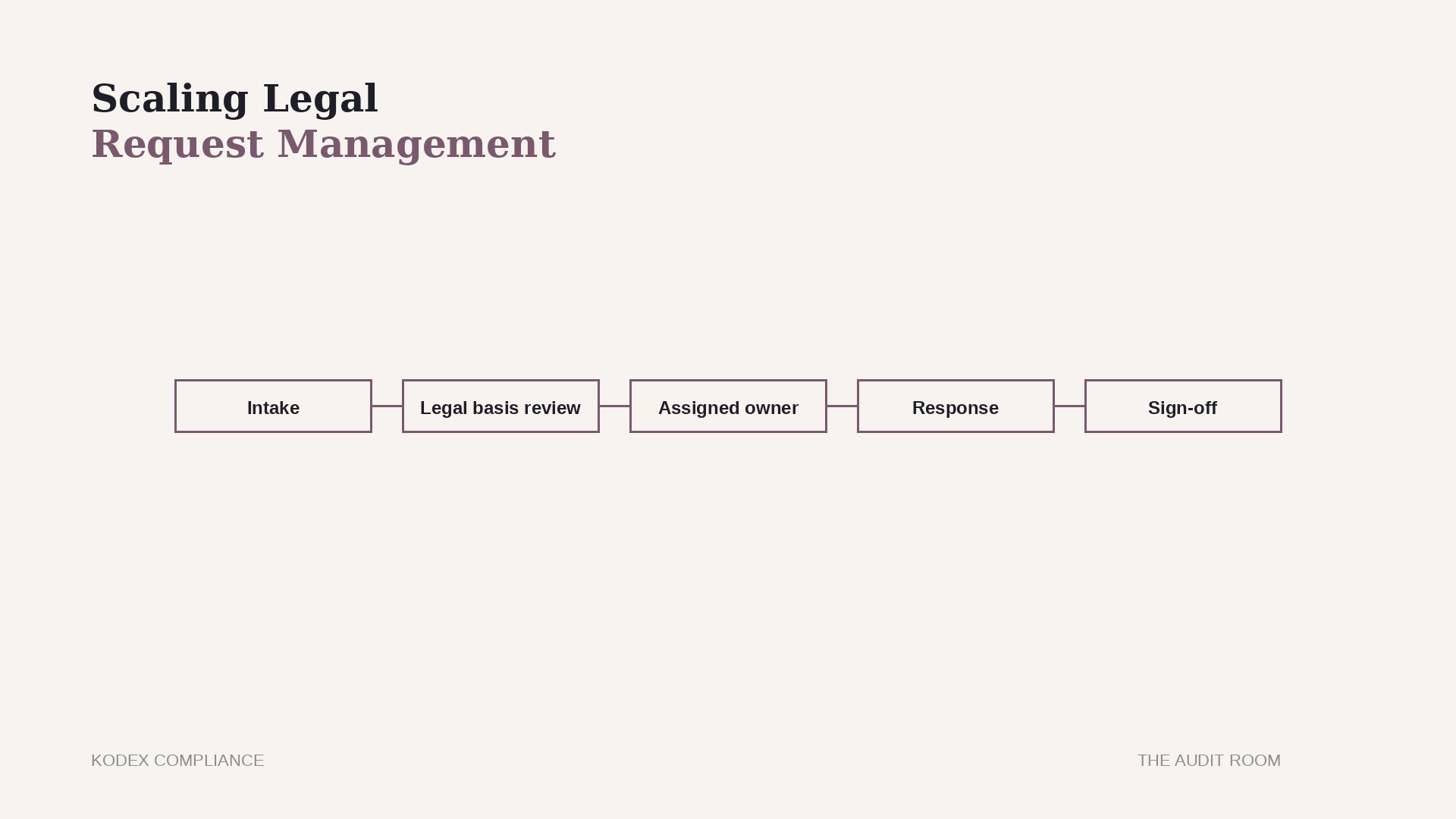
A defined workflow gives every request a consistent path: intake, legal basis review, assigned owner, response, and sign-off, with a deadline attached at each stage. That structure does not slow legal teams down. It removes the time spent figuring out who should handle a request and what has already been done on similar ones. It also creates a record by default, since each step leaves a trace, rather than requiring someone to write up the file afterward from memory.
Speed, consistency, and control
Speed matters because most of these requests carry a legal deadline, and missing it can carry its own consequences separate from the substance of the request. Consistency matters because platforms are increasingly expected to treat similar requests the same way, and an ad hoc process makes that hard to guarantee. Control matters because legal and compliance leadership need visibility into what is in flight, what is overdue, and where the exposure sits at any given time, not just after something has already gone wrong.
Where this fits into a broader compliance program
Legal request management works best when it is not treated as separate from the rest of the compliance program. At Kodex, the same model that governs security and privacy controls, a named owner, live evidence, and a review date, applies to how legal requests move through the organization, so speed and consistency come from how the process is structured, not from individual heroics under deadline pressure.
If legal request volume is starting to outgrow your current process, talk to Kodex about what a structured workflow would look like for your team.
Talk to Kodex: https://2gnhbv.share-eu1.hsforms.com/2Cd-BEz_vQv62FetiP_YmdQ
A note on this article
This article describes general operational practices for handling government inquiries and privacy requests. It does not cite specific statutes or deadlines, and it is not legal advice. Legal, tax, or law-enforcement obligations vary by jurisdiction and request type, so confirm specific requirements with qualified counsel.
Build the evidence trail
Kodex Compliance helps teams turn questionnaires, documents, implementation proof, and reviewer decisions into a clear compliance record.
Request demo